28/09/18
The Product Lifecycle
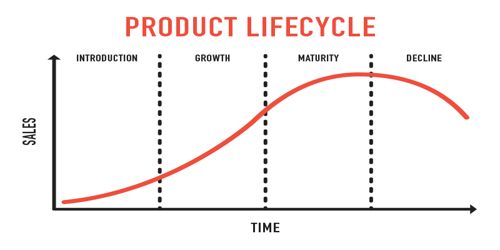
The product lifecycle is a theoretical model that describes/predicts the stages a product goes through during its lifetime. It can be used to forecast sales trends, work out which markets to target and where to position the product, analyze and manage a product portfolio, and to focus whether or not to invest in products. Whilst it is normally used for single products it can also be applied to a category of products, a style, or a brand/model. The phrase was first used by T Levitt in Exploit The Product Lifecycle – Harvard Business Review in 1965.
There are 5 stages to the product lifecycle, these are:
- Development
- Introduction
- Growth
- Maturity
- Decline/End
Development
- New Product Development (NPD).
- Can often be complex.
- Uses up a significant number of resources.
- May not be successful.
- May involve a long lead time before sales are achieved.
Introduction
- New product launched.
- Usually low sales.
- Low capacity utilization and high unit costs.
- Heavy promotion to make customers aware of the product.
- Usually negative cash flow.
Strategies to use in this stage
- Aim = Encourage customer adoption.
- High promotional spending to create awareness and inform people.
- Either skimming or penetration pricing.
- Limited, focused distribution.
- Demand initially from “early adopters”.
Growth
- Much faster-growing sales.
- product gains market acceptance.
- Unit costs fall with economies of scale.
- The market grows, profits rise but attracts the entry of new competitors.
- Cash flow may become positive
Strategies to use in this stage
- Promote brand awareness.
- Intensive distribution – many new outlets.
- Market penetration.
- Wider target customer base.
- Improve the product – new features, improve styling, more options.
Maturity
- Slower sales growth as rivals enter the market = Intense competition and fight for market share.
- Low unit costs = Very efficient.
- High profits for those with high market share.
- Weaker competitors start to leave the market.
- Prices start to fall.
- Cash flow should be strongly positive as there is less need for investment and marketing.
Strategies to use in this stage
- Manage capacity and production.
- Promotion focuses on differentiation.
- Intensive distribution.
- Adopt extensions strategies: Attract new and late customers, Develop new users, or reposition in the market.
Decline
- Falling sales.
- Market saturation.
- Rapid fall in profits and weaker cash flow.
- More competitors leave the market.
- Excess capacity and rising unit cost.
Why do products enter the decline stage?
- Technological advances.
- Changes in consumer tastes and behavior.
- Increased competition.
- Failure to innovate and develop the product.
Strategies to use in this stage
- Maintain market share of what’s left.
- Minimise marketing spend.
- Cut prices to stay competitive.
- Support loyal customers.
Criticisms of the product lifecycle
- The shape and duration of the cycle can vary from product to product.
- Strategic decisions can change the lifecycle.
- Hard to know precisely where a product is in its lifecycle.
- Length cannot be reliably predicted as the maturity phase can last a long time.
- A decline is not inevitable.
The impact of digital marketing on the product lifecycle
Development – Creators can get feedback at any time in a span of just 2-3 weeks. Digital marketing makes it easy for research organizations to digitally circulate their research questionnaires to a large audience.
Introduction – Digital marketing can be used to create brand awareness within the marketing channels targeted. Tools that can be used for this include content marketing, social media promotions, paid ads, and other SEO activities which help create awareness of the brand. This time is used to focus on creating an informative, user-friendly website with content related to the product.
Growth – During the growth stage products are promoted using banner ads, videos, blogs, articles, PPC campaigns, and social media posting such as Facebook, Twitter, and Instagram.
Maturity – With the help of digital marketing companies can elongate the maturity stage using strategies such as:
- Tapping into new market segments without extra costs.
- Brand reinforcement through cost-effective ways e.g. Email Marketing
- Offering incentives for a specific set of people e.g. a promotion only available on Facebook.
- Offering value-added benefits to customers.
- Dedicated SMS campaigns.
Decline – When the sales of a product are in a slump you can easily continue to market your product for free. This is useful if you want to leave the market as you can promote discount and deals in order to get rid of remaining stock. If you decide to release a new product in place of the old one, digital marketing will help to keep a loyal customer-base with no extra cost.
Digital marketing has huge potential and it’s all about the right strategy that will help you grab your share of the market.
Tasks
For this task, I am going to look at the product lifecycle in terms of PlayStation as my company does not have a traditional product or service that you could apply the product lifecycle to.
Development
Playstation develops a new game console on average every 7/8 years. They are different than many companies in terms of marketing during this phase however as they often announce that a new console is being developed months before it is released in order to generate excitement and pre-orders.
Introduction
The PS4 was released in November 2013 and by December that same year had already sold 4million units. This is a lot better than most products do in the introduction stage as they are already a well-known company that has been producing consoles for over 20 years. It is also due to the fact that they held a conference to announce the system in the development stage which helps consumers see what the product has to offer.
Growth
The PS4 entered its growth stage in mid-2014. By this time it was firmly established as the leading games console over its competitors the Xbox One and the Nintendo Wii U. During this stage it continued to establish its dominance by releasing multiple updates to make its UI even better as well as securing deals to make games the best on PS4. They also started creating different designs of PlayStations as well as improving the storage capacity and releasing a new product, the PS4 Pro, in late 2016.
Maturity
I would say that the PlayStation 4 is currently in the maturity stage of its product lifecycle as they are still innovating and releasing new features. However, it is rumored that there will be a PS5 in the coming years. This will of course negatively impact the sales of the PS4. But, whilst the PS4 is PlayStations flagship product they will continue to bring the best experience to consumers. Recently, Nintendo released a competitor to the PS4, the Nintendo Switch, this has forced PlayStation to not sit back on their laurels and to keep providing great games and a great service to their consumers despite their dominant market share.
Decline
It is expected that the PS4 will enter the decline stage in the next year as new consoles are announced and released. However, we can try to predict what will happen based on previous products such as the PS3.
The PS3’s decline was a successful one for PlayStation (as far as declines go). During the end of its lifecycle, it managed to outsell the competitor, the Xbox 360. This is due to the fact that PlayStation provided great games towards the end of its lifecycle and even continued to support it after the PS4 was released.
Task Two:
A Marketing Matrix for Playstation.
| Development | Introduction | Growth | Maturity | Decline | |
| Product | Development of the PS4 begins at this point. | At this point the PS4 was launched to the market along with all sorts of different bundles that it could be purchased in. | Different variations of the PS4 were released including limited edition PS4s as well as ones with upgraded hardware. | In this stage the PS4 was supported by various amazing games and services that could be purchased alongside the system itself in order to keep sales high. | The PS4 has not yet hit this stage but when it does in the next year it will likely continue to be supported by great games as well as the various other services playstation offer. |
| Price | Decisions were starting to be made about how much the PS4 should cost. | The PS4 was priced around £100 lower than its biggest competitor at launch. A very competitive price. | The price of the original PS4 began to drop whilst the newer PS4s had a higher price point to ensure everyone could get one if they wanted one. | The PS4’s price slowly began to fall in order to accommodate consumers that could not originally afford one. | As it starts to reach the decline stage one would imagine that the price of the PS4 will start to fall in order to entice the late comers to the market to buy one. |
| Place | Deciding on what sites/shops the PS4 will be sold. | You could buy the PS4 in all major online retailers. | You could buy the PS4 in all major online retailers. | In the maturity stage not much changed to do with place, it still continues to be sold on various online and physical stores. | The PS4 will continue to be sold across a multitude of different online stores. |
| Promotion | At this stage PlayStation announced that the PS4 was in development to start to generate hype for it. | Major pushes in promotion including social media campaigns and TV Ads were created to let the consumer know the PS4 was “The best place to play” | Yet more online campaigns and TV ads as well as billboards around the world displaying the playstation logo. PlayStation continued to sponsor the UEFA Champions League. | As the PS4 entered the maturity stage the consistent promotion across a variety of different avenues continued to grow along with the popularity of the product. | Im sure that promotion will still be going strong for the PS4 right up until the PS5 is released as at this point PlayStation will want to put their full support behind their newest product. |
| People | At this point you could sign up to receive emails about the newest updates on the PS4 and social media accounts started to post about it. | Constant social media updates, emails, and new blog posts were released to consumer in order to convince them to buy the PS4. | Playstation developed a live chat support system to assist consumers with any problems they may have with the product. As well as continuing to offer support on social media channels and emails and blogs. | Emails consisting of the latest updates about the work of playstation continued to be rolled out to subscribers along with daily blog posts on their website. | In the decline stage of its lifecycle, PlayStation will continue to offer customer service to the same award winning level that they currently are. |
| Physical Evidence | At this stage PlayStation used their already strong brand in order to keep consumers that had already bought their products interested in the PS4. | Early reviews were coming in for the PS4 which were all very positive. Much better performing than the closest competitor. | As the sales of the PS4 skyrocketed more and more people were trusting that it was indeed the best product of its kind on the market. | Multiple exclusive PS4 games received rave reviews at this point. This drove more gamers to choose the PS4 as their favourite console to game on. | The many positive reviews and sales figures will prove to late comers that the PS4 is a stellar product that deserves their attention. |
| Process | Process was not used too much at this stage aside from social media posting to inform consumers. | PlayStation made their website easy and simple to navigate in order to find what you want. | PlayStation continued to fine tune the processes used to navigate their website and social media channels. | PlayStation continued to fine tune the processes used to navigate their website and social media channels. | As the product dies down PlayStation will focus on refining their website for the next console to take its place. |


Leave a Reply